
Mental wellness at work — private for people, measurable for HR.
MindFit is an AI-powered workplace wellness platform that combines licensed counsellors, an always-on AI companion, mood tracking and wellbeing journeys — with anonymised organisational insights HR can act on without ever seeing personal data.
The one-glance view — what the engagement was, who it was for, and where I owned the work.
Workplace wellbeing is under-served on one side and unmeasurable on the other.
Employees don't lack goodwill from their employers — they lack accessible, non-stigmatising support. And HR teams, even when they invest in an EAP or a therapy stipend, can't tell whether any of it is actually working. The result is real spend on wellbeing programmes with no line of sight into outcomes, and a workforce that quietly disengages long before anyone notices.
Access is friction-loaded
Booking a first therapy session means overcoming stigma, waiting weeks, and hoping the counsellor is a fit. Most people quietly give up before the appointment.
Privacy blocks measurement
Anything individually identifiable is (rightly) off-limits to HR. So programmes exist in a black box — leaders can't tell if the investment moved the needle.
One-size support fails
A single benefit rarely meets a whole workforce. Some people need a therapist; others need a check-in; others need a wellbeing journey they can do privately.
A platform where humans handle depth — and AI handles daily consistency.
The opportunity wasn't to replace therapists with a chatbot; it was to design a platform where licensed professionals sit at the centre, AI extends daily support between sessions, and HR sees aggregated, privacy-preserving signals of what's working. Done right, this closes both gaps at once: the access gap for employees, and the measurement gap for HR — without a single trade-off between them.
Lower the on-ramp
An AI companion available 24/7 removes the intimidating first step and helps people articulate what they need before booking a human session.
Keep humans at the centre
AI complements licensed counsellors — it doesn't diagnose, doesn't replace, and always routes real distress to a human quickly.
Prove impact ethically
Anonymised, aggregated wellbeing signals give HR the visibility they need to justify and improve the programme, without violating a single individual's privacy.
Research grounded in the people who'd actually use it.
Before a single wireframe, I ran discovery across all three sides of the platform: the employees who'd use it, the HR leaders who'd fund it, and the licensed counsellors who'd deliver care through it. Their conflicting needs — deep privacy, meaningful insight, professional workflow — became the design brief.
1:1 employee interviews
Conversations with employees across roles surfaced how, when, and why they'd actually use a workplace wellbeing tool — and what would immediately break trust.
HR & benefits leader sessions
What HR teams already had, what they wished they could measure, and where existing EAPs and benefits repeatedly fell short.
Counsellor consultation
Licensed mental health professionals defined the ethical lines around AI, what a safe intake flow looks like, and how the tool should route escalations.
Competitive landscape audit
A structured review of existing corporate wellness tools — where they underserved employees, where they under-delivered for HR, and where the gap was real.
User journey.
Employee — Learns MindFit exists via HR
Employee — Private profile, first mood check-in
Employee — Daily companion + a wellbeing journey
Employee → Counsellor — Books a human session when needed
HR — Sees anonymised org trends, plans next quarter
Calm, warm, credible — never clinical.
The design system had to hold two moods at once: consumer-warm on the employee mobile app, and enterprise-serious on the HR dashboard. One typographic voice, one colour language, one motion character — surfaced differently for each audience.
Body copy is generous in size and line-height — reading anything about wellbeing should feel unhurried. Weights stay light and contrast stays deliberate so the interface never shouts.
Display face uses a humanist geometric sans; body pairs a highly-legible neutral sans. Both are optimised for long-form reading on small screens.
- 01Privacy is a visible design element, not fine print.
- 02AI presence is always transparent — never masquerading as human.
- 03Copy is warm and specific; no clinical jargon.
- 04Motion is gentle — nothing snaps, nothing jumps.
Three interfaces, one coherent product.
MindFit runs on three audience-specific surfaces — the employee mobile app, the HR web dashboard, and the counsellor session workspace. Each is designed for its context; all three share the same design language so nothing feels like a bolt-on.
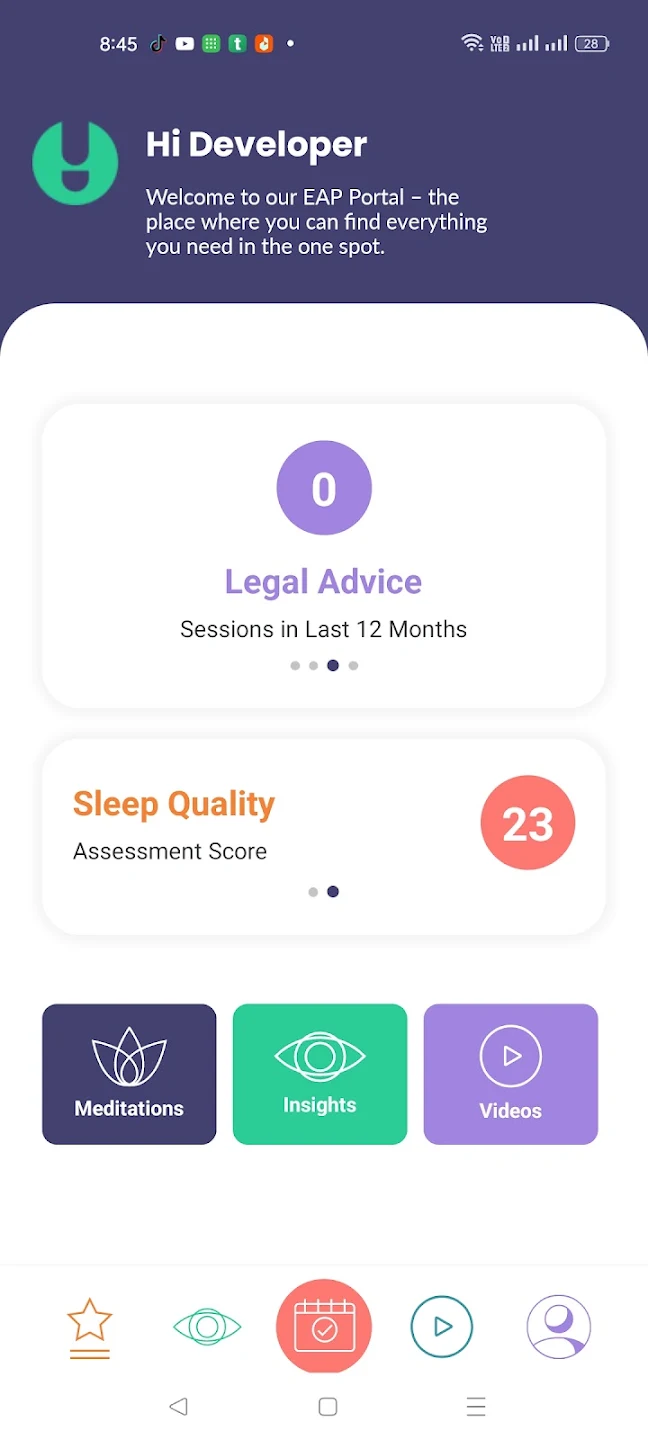
The employee app — daily, quiet, private.
The mobile experience opens on a two-tap check-in. From there the person can chat with the AI companion, pick up a wellbeing journey, or book time with a counsellor — always inside a space that reads as theirs, never as their employer's.
- One-tap mood check-in, no compulsory forms
- AI companion available 24/7 — clearly labelled as AI
- Direct booking into a licensed counsellor's calendar
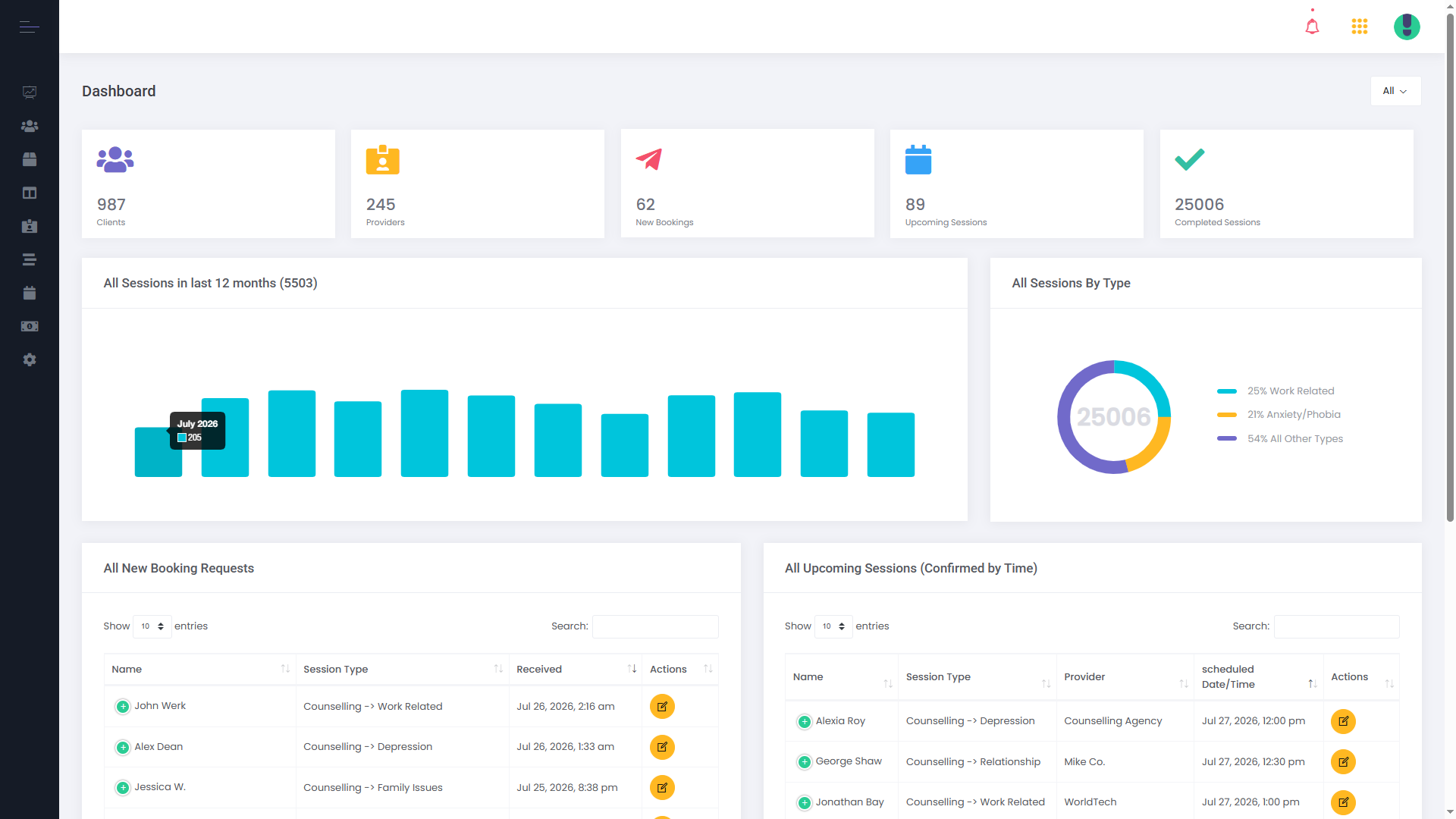
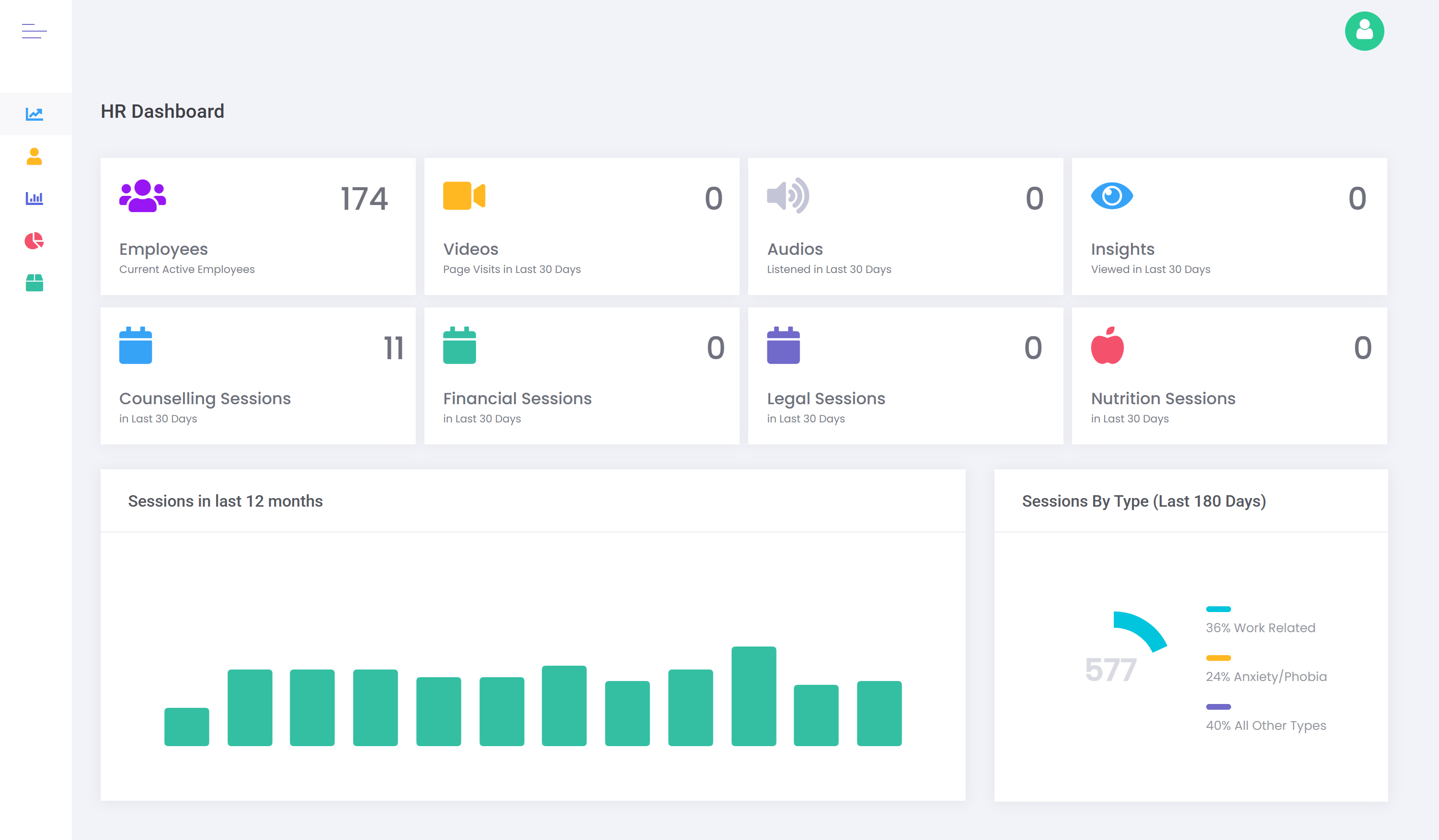
The HR dashboard — insight without intrusion.
HR leaders see the health of their programme at a glance — engagement, journey completion, aggregate wellbeing trends, and early team-level signals. Every metric is aggregated, anonymised, and gated by a minimum cohort size so no single person is ever identifiable.
- Aggregate-only reporting with strict cohort minimums
- Trend detection surfaces team-level risk before individuals
- Exports and briefings are annotated with privacy guarantees
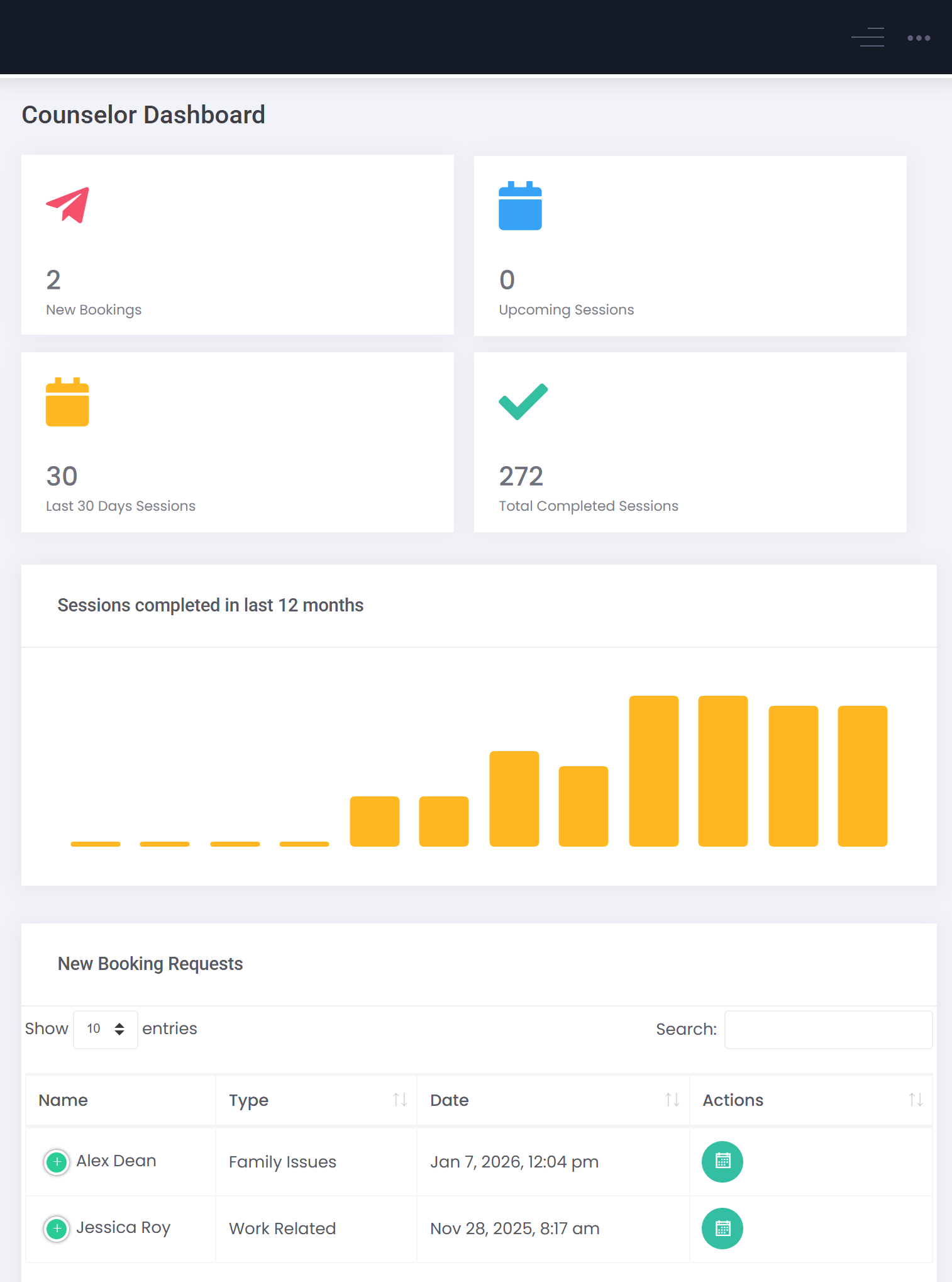
The counsellor workspace — calm and focused.
For licensed professionals the workspace is a distraction-free surface: today's sessions, secure notes, and the exact context they need — without ever exposing raw AI-companion transcripts. AI stays in a supporting role, never in the therapeutic seat.
- Session-first UI: today's calendar, one client at a time
- Encrypted notes with structured intake context
- Clear handoff protocols for escalations
Capabilities framed as outcomes, not a feature list.
Each capability answers a specific business or user need — from lowering the on-ramp to talking about mental health, to giving HR the first honest measurement they've ever had of programme impact.
AI wellbeing companion
An always-on, empathetic conversational partner that helps people reflect, articulate, and — when appropriate — book time with a licensed human.
Licensed counselling
In-platform booking, secure sessions, and structured intake so counsellors start every conversation with useful context instead of paperwork.
Mood & wellbeing tracking
Lightweight daily check-ins that build a personal trend line — visible only to the person themselves, never to their employer.
Wellbeing journeys
Guided, structured programmes for sleep, stress, anxiety, focus and burnout — designed with clinicians, delivered like a great product.
HR insights
Aggregate, anonymised, cohort-minimum-gated organisation dashboards that finally let HR measure programme impact without violating privacy.
Privacy by design
Personal data is compartmentalised, encrypted, and never visible to employers — with clear, plain-language guarantees users can actually understand.
Built for scale, privacy, and clinical trust.
The system is designed around a hard boundary between personal data and organisational data. Aggregation happens close to the data source, and no path exists for organisational users to reach individual records — architecturally, not just via UI.
Frontend
Two audience-specific applications sharing one design system: a consumer-grade mobile app and an enterprise web dashboard.
Backend
A domain-driven service layer with clear boundaries between personal, clinical, and organisational contexts — each with its own authorisation model.
Data
Separate stores for personal, clinical, and organisational data. Aggregations are computed with cohort-minimum guardrails baked into the query layer.
AI layer
LLM-powered companion with clinician-authored safety scaffolding: crisis detection, escalation to human, and hard scope boundaries around clinical claims.
Security & compliance
SSO, role-based access, at-rest and in-transit encryption, audit trails, and privacy guarantees explained in plain language on-surface.
Cloud & infrastructure
Multi-region deployment with automated CI/CD, observability from day one, and a runbook for both engineering incidents and clinical escalations.
What the product unlocks for the businesses that adopt it.
MindFit is designed so success is the same on both sides of the platform — employees actually using support, and HR finally being able to prove the programme is working.
A 24/7 AI companion and in-platform counsellor booking replace weeks-long waits for a first session.
Aggregate, cohort-minimum-gated reporting gives HR the first honest read on programme impact.
AI extends the reach of licensed counsellors — clearly labelled, safety-scaffolded, never a stand-in for care.
The product that made mental wellbeing measurable — safely.
The thing that made MindFit work wasn't the AI, and it wasn't the dashboard. It was the discipline of designing them as a single system, with privacy as a visible feature rather than a fine-print concession. When strategy, UX, AI and architecture come from one workflow, the result is a product employees trust and HR can act on — which is exactly what this category has been missing.